Dear Dr. Lee, I am delighted to inform you that the review of your Research Article 6924314 titled A REVIEW OF DOSES FOR DENTAL IMAGING IN 2010 – 2020 AND DEVELOPMENT OF A WEB DOSE CALCULATOR has been completed and your article has been accepted for publication in Radiology Research and Practice.
Acceptance letter from Radiology Research and Practice, October 26, 2021
Background
Dental imaging is one of the most common types of diagnostic radiological procedures taken by the average person. Popular dental imaging procedures include intraoral radiography, which has the longest history of use, followed by panoramic radiography, and more recently, cone beam computed tomography (CBCT). All three procedures expose different portions of the head, from small parts of the teeth to the whole lower head, to ionizing radiation. There are concerns about the increasing use of imaging procedures as well as the resulting radiation dose, especially for pediatric patients.
Many studies report organ doses from dental imaging procedures estimated by measurement or simulation. However, there are few resources that summarize a variety of data and present the radiation dose with a user-friendly interface. The current study was intended to provide easy access to the radiation doses delivered by dental imaging procedures for the period of 2010 – 2020 and comparison with other radiation sources that are commonly faced in daily life. We established a comprehensive table of organ doses for dental imaging procedures by extracting data from the literature, and developed a user-friendly web application to present the summarized information.
Findings
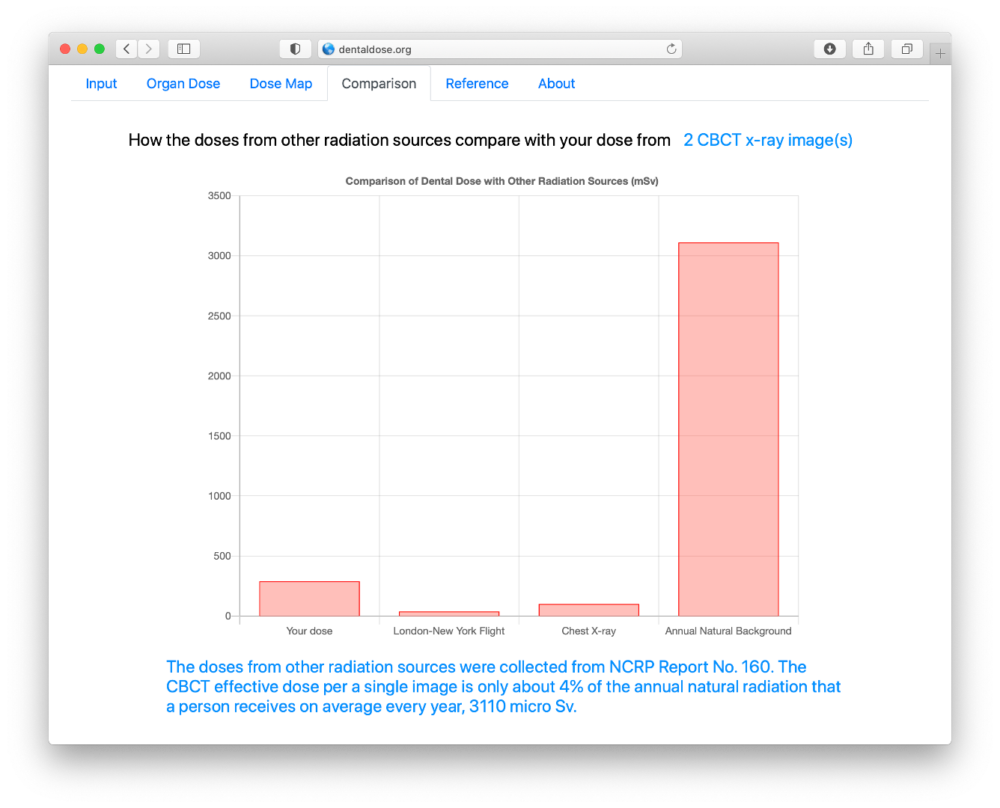
Mean effective doses delivered by intraoral, 1.32 (0.60 – 2.56) mSv, and panoramic, 17.93 (3.47 – 75.00) mSv, procedures are about 1% and 15% of that delivered by CBCT, 121.09 (17.10 – 392.20) mSv, respectively. In CBCT imaging, child phantoms received about 29% more effective dose than adult phantoms. The effective dose of a large field-of-view (FOV) (>150 cm2) is about 1.6 times greater than that of a small FOV (<50 cm2). The maximum CBCT effective dose with a large FOV for children, 392.2 mSv, is about 13% of the annual natural radiation that a person receives on average every year, 3110 mSv.
Web Dental Dose Calculator
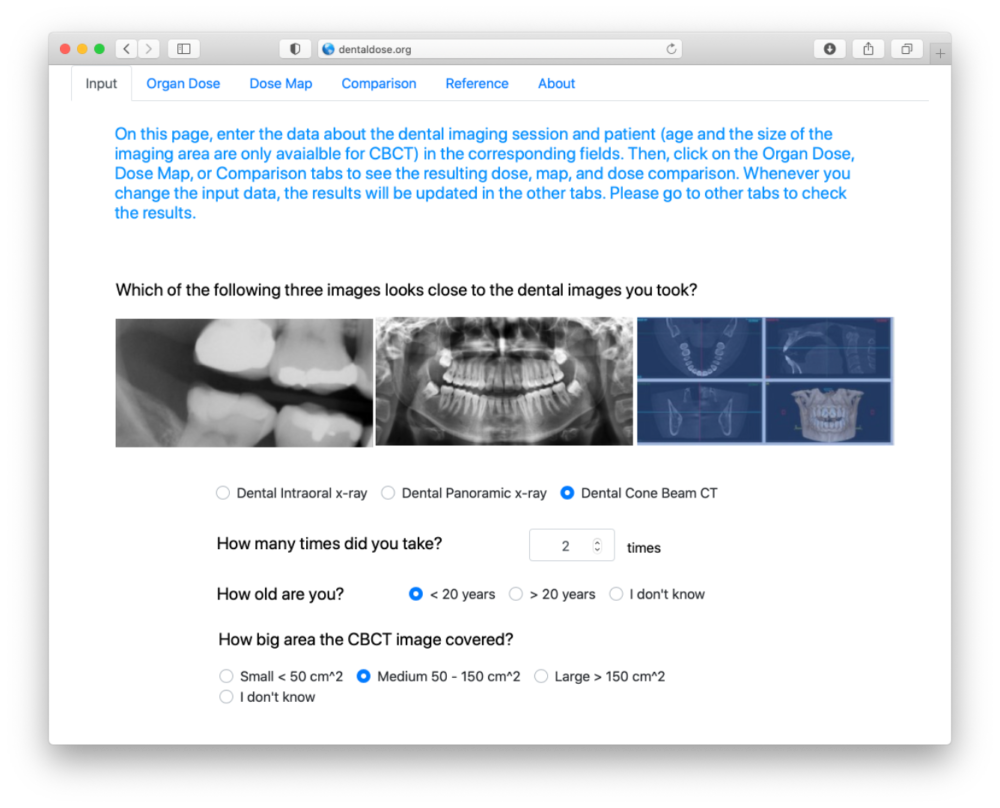
USER INPUT
The web program was designed to allow an input from the user for the following parameters: type of imaging modalities, number of image sets, patient age group (child or adult), and size of imaging region, which is the area of the FOV (small < 50 cm2, medium 50 – 150 cm2, and large > 150 cm2).
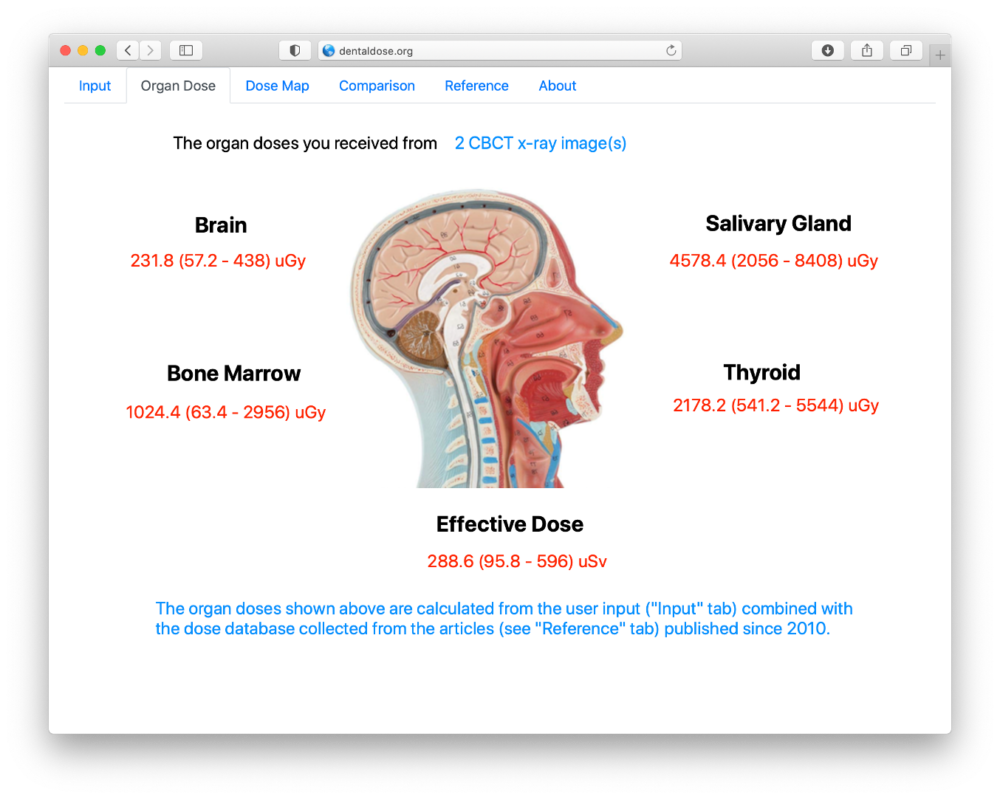
ORGAN DOSE
The web program will show dose delivered to the bone marrow, brain, salivary glands, and thyroid and effective dose, which are calculated by multiplying the dose per imaging by the number of image sets inputted by a user.
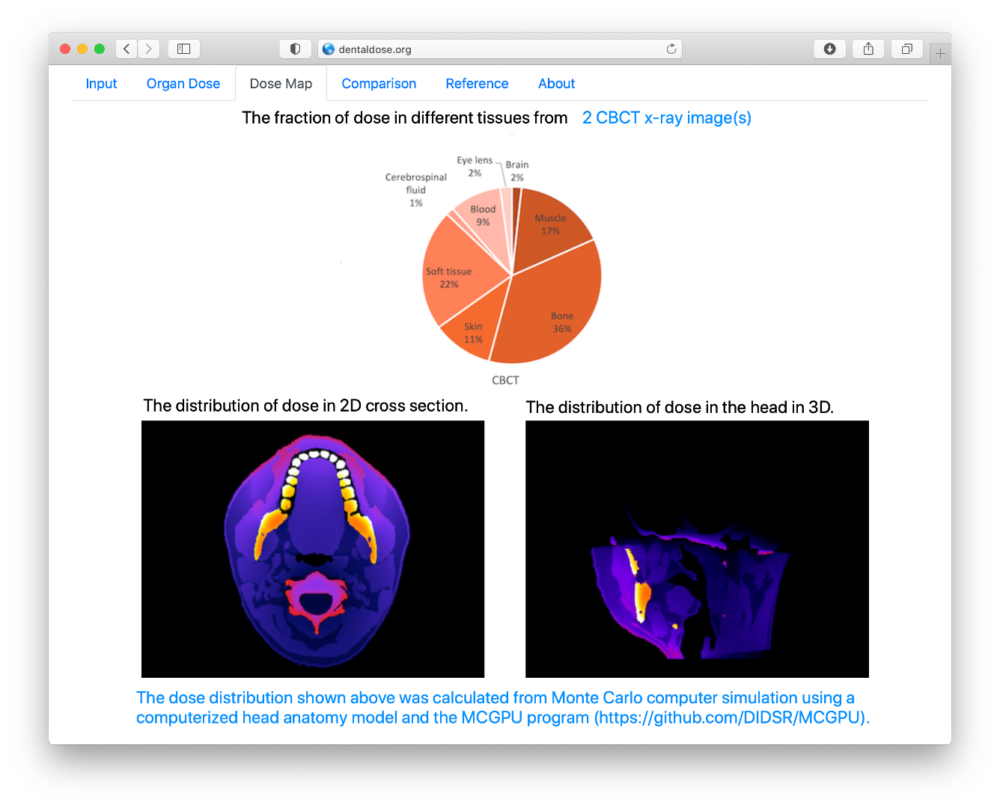
DOSE DISTRIBUTION
The web program will show the 2D and 3D dose distribution for the selected imaging procedures, and the fraction of dose delivered to different tissues